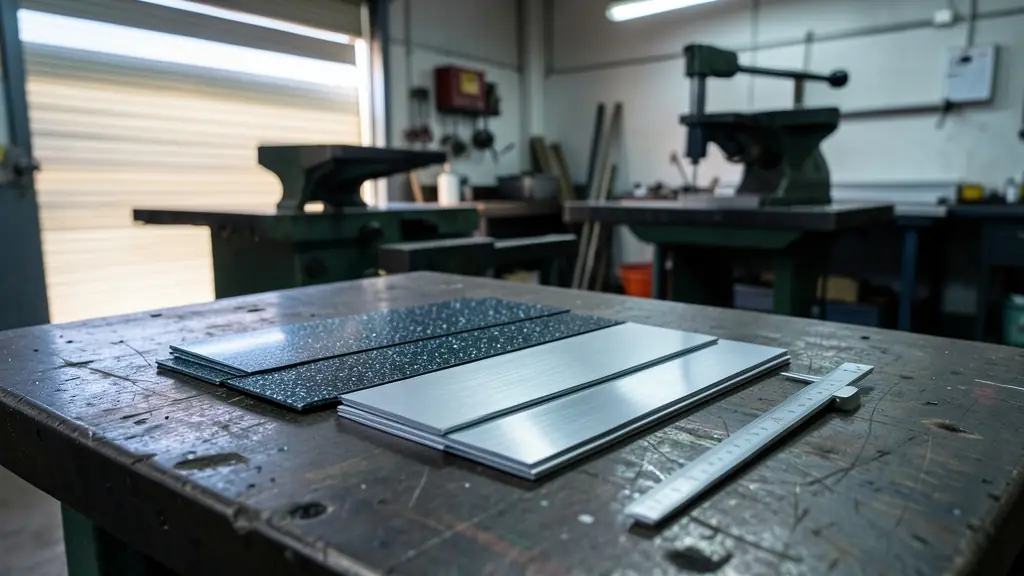
Gauge lives on in old drawings, imported parts lists and workshop talk, yet sheet in South Africa is bought by its thickness in millimetres. Each gauge table is different: 18 gauge is about 1.21 mm in steel, 1.31 mm in galvanised and 1.02 mm in aluminium. This converter works in both directions across five systems and names the metric size to ask for. Thickness in general is covered under sheet sizes and thickness.
Which gauge system should I choose?
Match the material and where the number came from. American steel drawings use the manufacturers' standard gauge. Galvanised sheet has its own, slightly thicker table because the zinc is counted, stainless has another, and aluminium follows the Brown and Sharpe gauge. Old British and local plans may use the imperial standard wire gauge. The ticket lists the same gauge in the other systems, and when those spread widely, ask whoever wrote the number which table they meant.
What does the converter show?
From a gauge it gives the thickness to three decimals, the nearest stocked metric size and kg per m² of flat sheet. Steel at 16 gauge is 1.519 mm, so the closest stocked size is 1.5 mm, at about 11.9 kg per m². Type millimetres instead and it works backwards, naming the closest gauge in each system. A 0.47 mm roof sheet reads as 26 gauge on the steel table and 28 on the galvanised one, which is why two people can name different gauges for the same sheet.
Why does the stocked size differ from the gauge?
Mills here roll metric sizes such as 0.5, 0.8, 1, 1.2, 1.6, 2, 3 and 4 mm, and roof sheet commonly from 0.4 to 0.58 mm. A gauge rarely lands on one exactly, so the converter picks the nearest. For a part that must fit, such as a bracket in a slot or a panel in a frame, decide whether the thinner or thicker neighbour is safer before ordering. Roof sheet is often quoted by base metal thickness before coating, which is less than the total coated thickness, so ask which one a quote means.
How should I write the thickness on an order?
Give the millimetres, the material and grade, any coating and the sheet size, for example 1.2 mm cold rolled mild steel, 1225 x 2450 mm. Keep the gauge in brackets when it came from a drawing, so the supplier can check it. To see what the order weighs, carry the thickness over to the sheet weight calculator. Grades and coatings are on the stainless steel sheets and galvanised sheets pages.
Frequently asked questions
How thick is 20 gauge steel?
About 0.91 mm on the manufacturers' standard gauge, so you would buy 0.9 mm sheet. On the galvanised table, 20 gauge is about 1.01 mm, closer to 1 mm.
What gauge is 1 mm aluminium?
About 18 gauge on the Brown and Sharpe table, which is 1.024 mm. The next one up, 16 gauge, is near 1.29 mm, and 20 gauge is about 0.81 mm.
Is a higher gauge number thicker?
No, it runs the other way: the bigger the number, the thinner the sheet. Steel at 10 gauge is about 3.4 mm, while 30 gauge is roughly 0.3 mm.
Why is my roof sheet sold as 0.47 and not as a gauge?
Roof sheet here is sold by base metal thickness in millimetres. Common figures are 0.47 and 0.5 mm, with 0.4 mm on light sheds and 0.58 mm where a heavier sheet is wanted.
Read more
More tools
- Roof sheeting calculatorRoof shape, eaves length, sheet run and profile: sheets to order, the cut length, end laps and ridge capping
- Sheet weight calculatorMaterial, shape, thickness, length, width and count: the total mass, each sheet, kg per m² and who can lift it
- Board calculatorWall, floor or ceiling size less openings, board size and cut allowance: boards to order, a grid count and the spare
- Plastic sheeting calculatorArea, edge turn ups, overlaps, micron and roll size: rolls to order, the strips, film used, its mass and the left over
- Polycarbonate expansion calculatorMaterial, sheet size, coldest and hottest sheet temperature and screw size: the movement, end gap and hole size