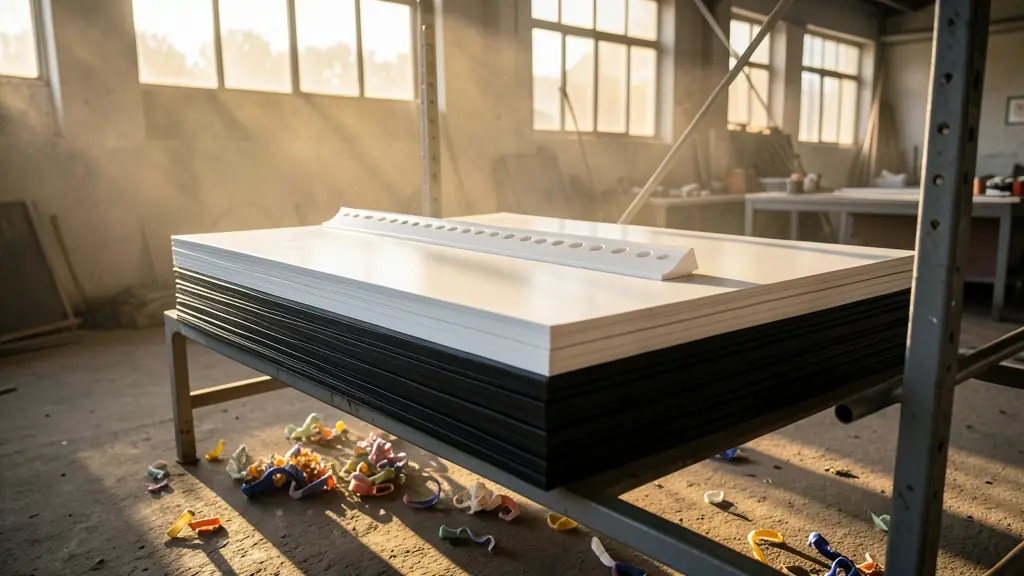
Chute liners at a Rustenburg concentrator, cutting boards in a Durban butchery and slide pads under a factory conveyor all start as thick plastic sheet, and each fails quickly if the wrong polymer goes in. Engineering plastics are picked by the job they must do: resist wear, slide, take heat, touch food or be formed. HDPE is the cheap, forgiving workhorse. The others earn their higher price only where HDPE falls short.
Price guide
A plastics distributor lists 2000 x 1000 mm HDPE sheet at about R989 for 3 mm to R3,933 for 12 mm, 2500 x 1250 mm ABS at about R449 to R1,495, and 1000 x 1500 mm polyurethane sheet at about R1,397 to R6,986, all incl. VAT.
A rough guide from published South African prices. Thickness, coating, length, cutting, delivery and VAT all move it.
Which plastic does which job?
| Plastic | Good at | Typical job |
|---|---|---|
| HDPE | low cost, food contact, chemicals | cutting boards, tank linings |
| UHMW polyethylene | wear, sliding, impact | chute and bin liners, wear strips |
| PTFE | heat to about 260 °C, very low friction | gaskets, slide pads, heat seal bars |
| Nylon | strength and stiffness under load | gears, bushes, rollers |
| ABS | vacuum forming | covers, caravan and bakkie trim |
| Polyurethane | abrasion and cuts | scraper blades, screen panels |
Teflon is a trade name used loosely for any PTFE sheet.
What lines a chute or a bin on a mine?
UHMW polyethylene lets wet ore, coal and sticky fines slide off instead of hanging up, and it shrugs off impact. Polyurethane goes where lumps strike hardest, and HDPE does for light duty. Liners are held with countersunk bolts in slotted holes so they can grow with heat. Mines usually want a data sheet with each order, and some underground work calls for flame retardant or antistatic grades. A fabrication shop often supplies the steel chute and the liner together.
Which plastics are safe for food?
Only food grade sheet, with a certificate from the supplier. Butcheries and kitchens use HDPE boards about 10 to 20 mm thick, often colour coded so raw meat and vegetables never share a board, and worn boards can be planed smooth again. Food machines use nylon and acetal parts. Keep recycled grades away from food, and pair the plastic with stainless steel worktops.
Anything to know before machining?
Plastics expand many times more than steel with heat, so a part measured on a hot afternoon changes by morning, and tolerances must allow for it. Nylon also takes up moisture and swells. Use sharp tools and light cuts to keep heat down. Sheets commonly measure about 1 x 2 m or 1.22 x 2.44 m, from about 3 mm to 100 mm thick, and rods and tubes are sold too. The sheet weight calculator estimates the mass for transport.
Who asks for this
- Homeowners and DIY
- A thick HDPE chopping board, a PTFE baking sheet or nylon parts for a gate.
- Builders and contractors
- Slide pads under bridge bearings or wear strips on a mixer chute, on the engineer's say.
- Farms and smallholdings
- HDPE linings in feed troughs and sorting tables, UHMW strips on packhouse lines.
- Factories and workshops
- Conveyor wear strips, guide rails, gears, bushes and heat seal pads on machines.
- Shopfitters and signwriters
- Butchery and restaurant cutting boards and ABS trays formed for displays.
- Schools, clinics and municipalities
- Hospital kitchen boards and HDPE wall protection in school and clinic corridors.
- Mines and plants
- UHMW and polyurethane liners in chutes, bins, hoppers and screen decks.
- Resellers, fabricators and installers
- Fabricators and machine shops buying full sheets and rods to cut parts for clients.
Frequently asked questions
Is ABS the same as acrylic?
No. ABS is opaque, tough and forms easily over a mould when heated, while acrylic is clear, harder and more brittle. Vacuum formers mostly work in ABS.
Can PTFE be glued in place?
Plain PTFE resists almost every adhesive. An etched grade with one treated face will bond; otherwise it is clamped, screwed or held in a recess.
How hard should a polyurethane liner be?
Hardness is measured on the Shore A scale, and wear liners commonly sit somewhere around 80 to 95. Softer grades take impact better, harder ones resist sliding wear; ask the supplier to match it to your material.
Can HDPE be welded or glued?
Welded, yes: fabricators join HDPE tanks and liners by extrusion or hot plate welding. Glue grips it poorly, so mechanical fixing or welding is the norm.