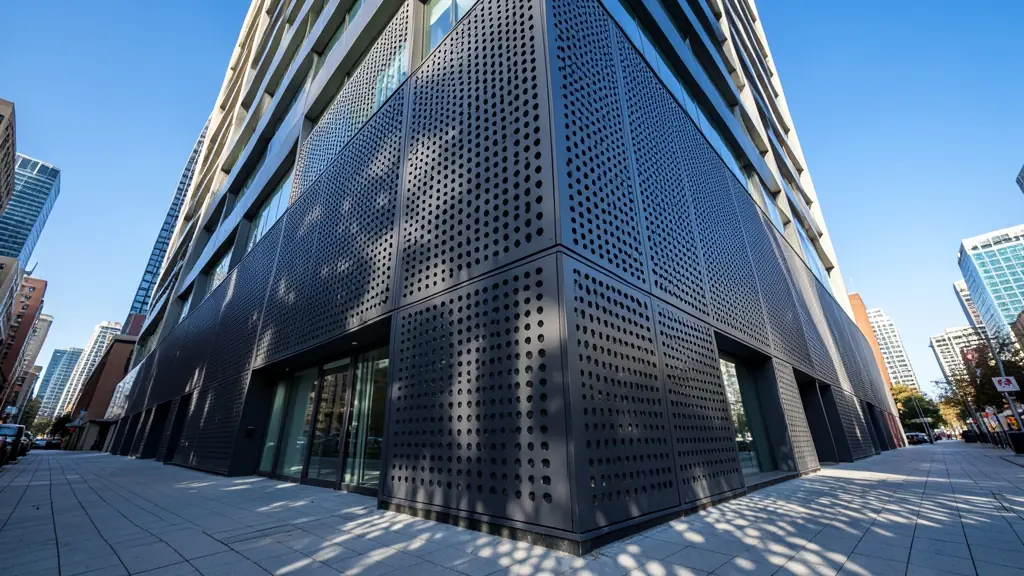
A perforated sheet is ordered by three figures: the hole size, the pitch between hole centres and the open area, which is the share of the sheet that is holes. Change one and the panel looks, filters and bends differently. Those figures decide whether a screen hides a car park, whether a guard keeps fingers out of a belt drive, and whether a sieve in a Malmesbury grain store lets the right kernels through.
Price guide
Full size perforated sheets are quoted per order; for expanded metal, steel merchants and a hardware chain list 1200 x 2400 mm sheets at about R215 to R655, and an expanded metal maker lists its stock sheets at about R290 to R1,149.
A rough guide from published South African prices. Thickness, coating, length, cutting, delivery and VAT all move it.
How do hole size and pitch set the open area?
The most common pattern is round holes on a staggered 60 degree grid. Open area rises fast as holes grow relative to the pitch:
| Hole and pitch (mm) | Open area, roughly |
|---|---|
| 2 on 3.5 | 30% |
| 3 on 5 | 33% |
| 5 on 8 | 35% |
| 10 on 15 | 40% |
More open area means more air and light, less strength. Most suppliers leave plain margins around the edge for fixing; ask for them on the drawing.
Round, slotted or square holes?
Round holes are the cheapest and strongest pattern and suit general screens and guards. Slotted holes grade by thickness rather than diameter, so seed, maize and mineral sieves often use them. Square holes give the highest open area for a given strength and a neat look on balustrades. Mild steel, galvanised, aluminium and stainless are all perforated; thickness commonly runs from about 0.8 mm to 3 mm for punched patterns.
What is it actually used for?
- Machine guards that let an operator see the belt while keeping hands out; a guard supplier sizes holes to the distance from the hazard.
- Sieves and grading screens in packhouses, mills and plants, which wear and are replaced by size.
- Acoustic panels: perforated ceiling or wall sheet backed with insulation soaks up noise in a school hall or call centre.
- Security and sun screens on windows, stoeps and facades.
- Decorative screens cut by laser in any pattern, from leaves to geometric shapes, then powder coated; see sheet metal fabrication for DXF files and cutting.
When is expanded metal the better buy?
Expanded metal is slit and stretched into diamonds instead of punched, so nothing is wasted and it is stiffer for its mass. It suits walkways, fences, burglar guards and plaster lath. It looks rougher and the diamonds snag, so visible screens and fine sieves stay perforated. Weigh both options with the sheet weight calculator, allowing for the holes.
Who asks for this
- Homeowners and DIY
- A laser cut garden screen, a pool pump cover or a stoep sun screen in powder coat.
- Builders and contractors
- Facade screens, balustrade infills and car park ventilation panels on architect drawings.
- Farms and smallholdings
- Grain and seed sieves, packhouse grading screens and vented feed bin panels.
- Factories and workshops
- Machine guards, dryer trays, filter backings and ventilated cabinet doors.
- Shopfitters and signwriters
- Feature ceilings, display backs and shop front screens cut in a custom pattern.
- Schools, clinics and municipalities
- Acoustic ceilings in halls, ventilated security screens and park bench seats.
- Mines and plants
- Screening decks and dewatering panels, often in heavier plate or polyurethane.
- Resellers, fabricators and installers
- Fabricators, shopfitters and guard makers ordering patterns in full sheets.
Frequently asked questions
Is laser cutting a screen better than punching?
Punching is far quicker and cheaper for repeat holes across many sheets. A laser cuts any pattern without tooling, so one off decorative screens and logos are its job.
Can I bend a perforated sheet?
Yes, but it bends less evenly than plain sheet, and holes near the fold stretch. Keep a plain strip where the bend falls.
Will a perforated screen keep burglars out?
Thick steel perforated sheet on a welded frame slows them down; thin aluminium screens are for shade and looks. For security ask for at least 2 mm steel and a fixed frame.
Who quotes perforated panels?
Perforating shops, steel merchants and laser cutters near you. They read your hole size, pitch, material and panel sizes and reply with their own prices.
Related topics
Work it out first
- Roof sheeting calculatorRoof shape, eaves length, sheet run and profile: sheets to order, the cut length, end laps and ridge capping
- Sheet weight calculatorMaterial, shape, thickness, length, width and count: the total mass, each sheet, kg per m² and who can lift it
- Sheet metal gauge converterA gauge number and system, or a thickness in mm: the millimetres, the nearest gauge, kg per m² and the stocked size