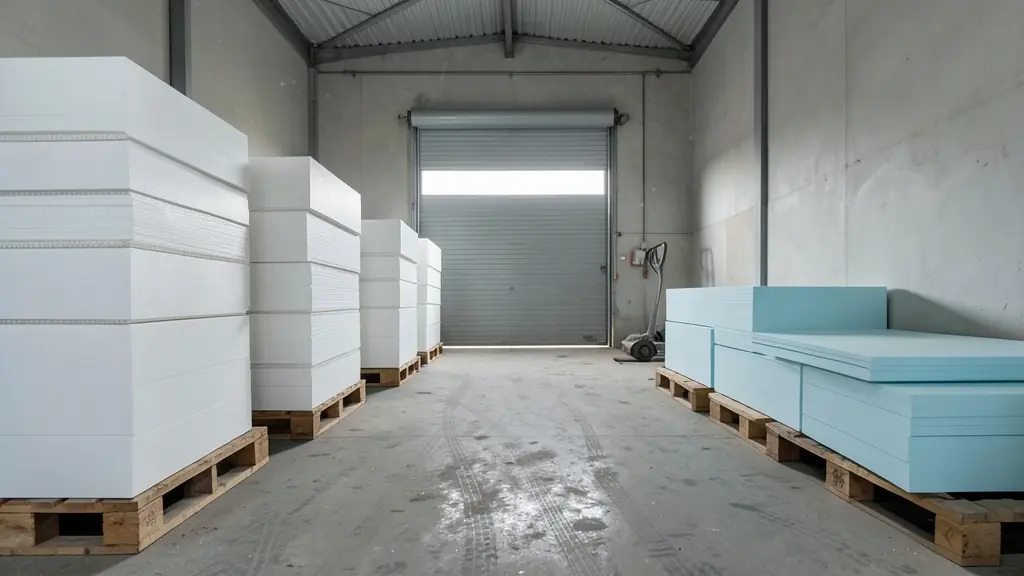
Two quite different foams are sold under the name polystyrene sheets. Expanded bead board, or EPS, is the white sheet that sheds little balls when you snap it. Extruded board, or XPS, is denser, smoother and usually tinted, with a closed skin that hardly takes up water. Order the wrong one and slab insulation sits in damp soil soaking it up, or a craft project costs several times what it needed to.
Price guide
A plastics distributor lists 1220 x 1220 mm EPS sheets at about R97.75 for 10 mm to R270 for 50 mm, incl. VAT, and a hardware chain lists a 1220 x 2440 x 20 mm EPS sheet at R345.
A rough guide from published South African prices. Thickness, coating, length, cutting, delivery and VAT all move it.
How do bead board and extruded board really differ?
| EPS bead board | XPS extruded board | |
|---|---|---|
| Look | White, visible beads | Smooth, tinted, fine cells |
| Density | Roughly 10 to 30 kg/m³ | Roughly 25 to 40 kg/m³ |
| Water | Takes some up when soaked | Very little |
| Under load | Softer, graded by density | Stiffer, suits slabs and roofs |
EPS costs far less per sheet and does most ceiling, packaging and wall jobs well. XPS earns its price where the board stays wet or carries weight.
Which board belongs under a slab or inside a wall?
Under a floor slab, designers commonly call for extruded board because it shrugs off ground moisture and holds its thickness under the concrete. The order of foam, DPM and screed comes from the designer, not the merchant. In cavity walls and behind dry lining, a firmer EPS grade often does the job. A thicker board insulates better; take the actual rating from the maker's sheet, and let the designer check what the building regulations ask of a new house.
Is a polystyrene ceiling safe?
Polystyrene burns, melts and drips, so foam in a roof or ceiling must be covered and kept clear of downlights, geyser flues and chimney pipes. Ask for a fire retardant grade, which is slower to catch but still not fireproof. Decorative ceiling panels and cornices are thin and light; if you want a ceiling that will not burn at all, look at fibre cement boards instead and check with your municipality.
What about packaging, crafts and cutting?
Boards are commonly sold at about 1200 x 600 mm or 2400 x 1200 mm, in thicknesses from roughly 10 to 100 mm, and many foam converters cut blocks and shapes to order. A hot wire leaves the cleanest edge on EPS but gives off fumes: work outdoors or with strong ventilation. A sharp knife or fine saw is fine for thin sheet. For courier quotes, the sheet weight calculator gives the mass.
Who asks for this
- Homeowners and DIY
- Ceiling panels, a cooler box liner, school projects and foam behind a garage wall lining.
- Builders and contractors
- Extruded board under slabs and bead board in cavities and behind dry wall linings.
- Farms and smallholdings
- Insulating a cold store, a hatchery room or a pump house against winter frost.
- Factories and workshops
- Packaging blocks cut to shape and insulation behind linings in drying rooms and cool rooms.
- Shopfitters and signwriters
- Lightweight display letters, props and backing boards for window displays.
- Schools, clinics and municipalities
- Insulated ceilings in school classrooms and clinic rooms, always covered and fire retardant.
- Mines and plants
- Temporary insulation and void fill for site offices and change house ceilings.
- Resellers, fabricators and installers
- Hardware stores and insulation merchants keep bead board in common thicknesses.
Frequently asked questions
Can I glue or paint polystyrene?
Yes, with the right products. Solvent based contact adhesive and most spray paints dissolve the foam. Use water based glue made for foam and acrylic paint.
Does polystyrene rot?
No, but rats and some ants will tunnel into it. Seal gaps where foam meets brickwork and keep it off open ground outside.
Why is extruded board so much dearer?
It takes more resin and a slower process to make. Buy it only where wet ground or heavy load calls for it.
Who will quote me for polystyrene sheets?
Foam converters, insulation merchants and packaging firms that deliver to your town. Our form forwards one request to several of them, each prices it for you, and sheeting.co.za keeps no foam of its own. Mention full sheets against cut blocks, because foam cutting is often a separate line.