Walk into a cabinet shop in Bellville and three boards do most of the work: raw MDF for painted doors and routed shapes, white or woodgrain melamine faced board for carcasses, and chipboard hidden under that melamine to keep the cost down. On a quote sheet they look alike. They behave very differently once water, screws or a router get to them, and that is where the choice matters.
Price guide
Hardware stores list raw 16 mm MDF of 1830 x 2750 mm at about R550 to R1,075 a board, and white melamine board of the same size at about R799 to R1,576.
A rough guide from published South African prices. Thickness, coating, length, cutting, delivery and VAT all move it.
Raw MDF, melamine board or chipboard?
| Board | Good at | Weak at |
|---|---|---|
| Raw MDF | Paint, routing, crisp edges | Swells when wet, heavy |
| Melamine faced chipboard | Carcasses and shelves, ready finish | Chips when cut, edges need banding |
| Melamine faced MDF | Fronts and doors with a clean edge | Heavier and dearer |
Boards are commonly about 2750 x 1830 mm or 2440 x 1220 mm, from about 3 to 32 mm thick, with 16 mm the usual cabinet carcass.
Which board survives a kitchen or bathroom?
Ask for a moisture resistant grade, often recognisable by a green tinted core, for sink cupboards, vanities and laundry units. It tolerates humid air and the odd splash. It does not tolerate standing water, so every cut edge still needs banding or sealing, and a leaking trap under the sink will ruin it in time. Raise kickplates on adjustable legs so a wet floor never touches the board.
Should I buy whole boards or cut and edged panels?
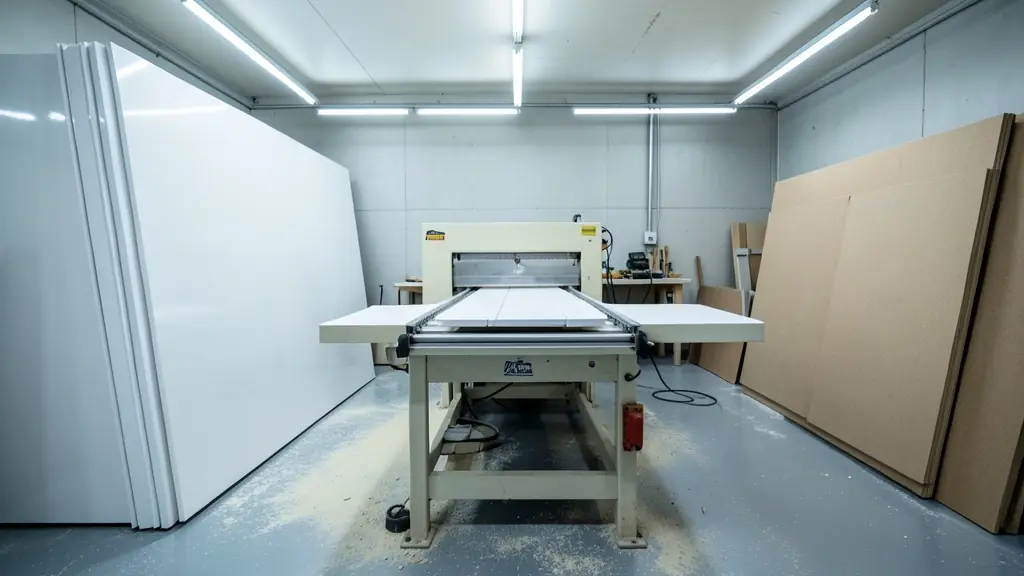
Board shops cut on a panel saw and band the edges by machine, which beats most home jigsaws for accuracy. Send a cutting list: each panel's length and width, the board and colour, grain direction on woodgrain, and which edges get banding. The shop fits your panels onto as few boards as it can and usually returns the offcuts if you ask. Load the cut panels flat in a bakkie with a blanket between faces, because melamine scratches. For a rough count first, use the board calculator.
Why do screws pull out of MDF?
Its edge has no grain to grip. Drill pilot holes, stay well back from corners, and use chipboard or confirmat screws, or cam and dowel fittings. Concealed hinges sit in a 35 mm cup bored a few millimetres in from the door edge. Cutting raises very fine dust that hangs in the air: use extraction or a vacuum, wear a P2 or FFP2 mask, and never sweep it up dry.
Who asks for this
- Homeowners and DIY
- Kitchen cupboards, built in wardrobes, a study desk and painted shelving units.
- Builders and contractors
- Fitted kitchens and cupboards on new houses and flats, cut and edged off site.
- Farms and smallholdings
- Packhouse office fittings and storeroom shelving, kept well away from damp.
- Factories and workshops
- Furniture production lines and jigs, buying boards by the pallet.
- Shopfitters and signwriters
- Shopfitting counters, display walls, slatwall panels and routed signs.
- Schools, clinics and municipalities
- Classroom cupboards, clinic counters and office fittings on government tenders.
- Mines and plants
- Site office desks and change house lockers, ordered with the fit out.
- Resellers, fabricators and installers
- Kitchen installers and board shops buying full boards to cut and edge.
Frequently asked questions
What is MDF board?
Medium density fibreboard: wood fibre mixed with resin and pressed flat, with no grain and no knots, so it machines and paints evenly.
Can MDF be used outdoors?
Ordinary MDF should not be. For outside work choose exterior plywood or fibre cement.
Is 16 mm strong enough for shelves?
For light loads, yes. Long shelves holding books or files tend to sag over the months, so keep spans short, add a centre support or glue a front rail along the edge. An 18 mm or 22 mm board helps on wider bays.
Who cuts and edges the panels for me?
Board shops and cabinet suppliers near you. Send us one request with your list and they quote you; we do no cutting ourselves.