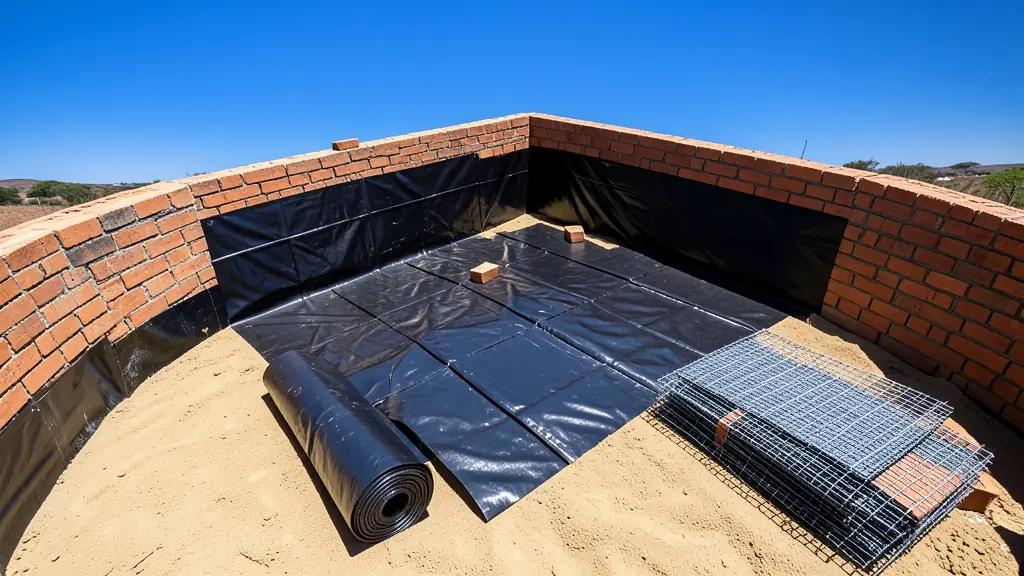
Film is sold by the roll, but a slab or a site is covered in strips, and each strip gives up width to the overlap and length to the turn up at the edges. This calculator lays the strips out and counts the rolls in the common sizes, at any thickness from 50 to 500 micron, along with the mass of plastic. What each thickness is for, from drop sheets to liners, is on the plastic sheeting page.
What exactly do I measure?
Measure the inside of the area the film has to cover. For a slab, that is the length and width inside the foundation walls or the shuttering; for a silage cover, the heap. Keep the 150 mm turn up for a slab edge, where the film rises against the wall, or set it to nil for a flat cover. The 200 mm overlap is what each strip shares with the next.
How does the tool lay out the strips?
It adds the turn up at both ends of each side, runs the strips along the longer side and counts how many fit across, each lapping its neighbour. Then it fits as many whole strips as it can into each roll. A 12 x 8 m slab becomes 12.3 x 8.3 m with turn ups. In 3 x 30 m rolls that is three strips of 12.3 m, two per roll, so 2 rolls with about 69 m² over. One 6 x 25 m roll does it in two strips with 2.4 m² to spare.
What does the micron figure change?
Micron is thickness in thousandths of a millimetre, so 250 micron is a quarter of a millimetre. At a density of about 0.92, that film weighs about 0.23 kg per m², and the slab above takes about 25 kg of it. Builders commonly use 250 micron as the damp proof membrane under a slab, as thinner film tears on stone and under boots. Drop sheets get by on 50 to 100 micron. The building regulations call for a damp proof membrane under a house slab; your builder or the inspector says what they accept.
What should the order say?
Give the micron, the colour, the roll size and the number of rolls, and say what the film is for: DPM under a slab, a UV stabilised film for anything left in the sun, or a silage film on a farm. Add tape made for polyethylene. The left over figure shows whether another roll size would waste less. A rigid liner is another product, covered under engineering plastic sheets.
Frequently asked questions
How many square metres are in a roll of builders' plastic?
It depends on the roll: 3 x 30 m holds 90 m², 4 x 25 m holds 100 m², 6 x 25 m holds 150 m² and 4 x 50 m holds 200 m². With overlaps and turn ups, the floor you can cover is somewhat less.
How heavy is a roll of 250 micron plastic?
A 3 x 30 m roll is about 21 kg, at roughly 0.23 kg per square metre. A 4 x 50 m roll of the same film is near 46 kg, a load for two people.
Should the joins be taped?
Usually, yes. An untaped lap can open when the wind gets under it or when concrete is placed, so most builders tape every join and patch each tear before the pour.
Who will quote me for the rolls?
Not sheeting.co.za, since we keep no film in stock. A single request goes to merchants and plastics suppliers serving your area, and they send their own prices for the rolls and tape.
Read more
More tools
- Roof sheeting calculatorRoof shape, eaves length, sheet run and profile: sheets to order, the cut length, end laps and ridge capping
- Sheet weight calculatorMaterial, shape, thickness, length, width and count: the total mass, each sheet, kg per m² and who can lift it
- Sheet metal gauge converterA gauge number and system, or a thickness in mm: the millimetres, the nearest gauge, kg per m² and the stocked size
- Board calculatorWall, floor or ceiling size less openings, board size and cut allowance: boards to order, a grid count and the spare
- Polycarbonate expansion calculatorMaterial, sheet size, coldest and hottest sheet temperature and screw size: the movement, end gap and hole size