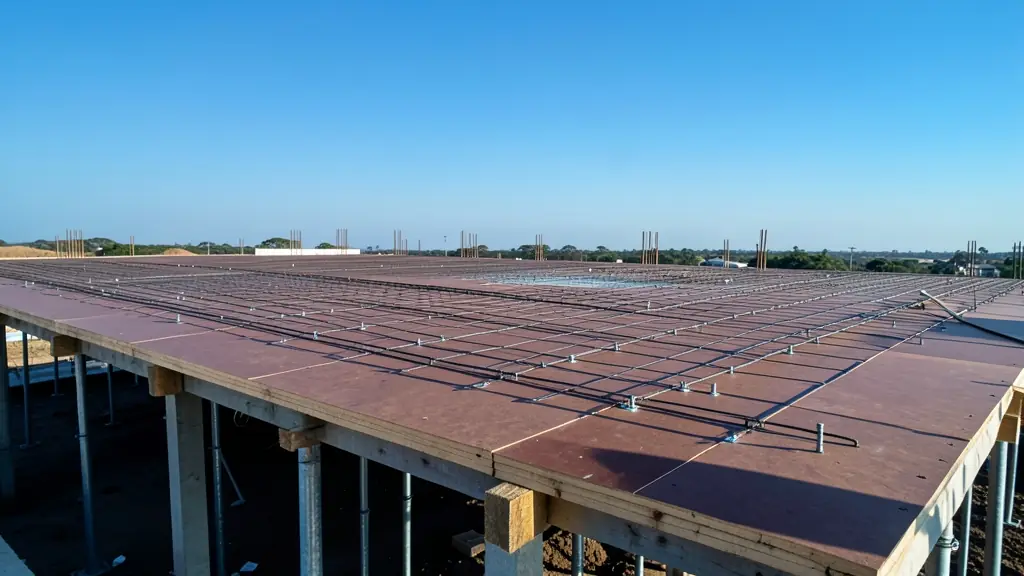
A slab in Midrand can be shuttered with pale plain ply or with dark brown film faced board, and the choice shows up twice: in the finish on the concrete soffit, and later when you count how many pours the boards survived. Shutter board is plywood made to meet wet concrete, bought mostly in 18 mm, and how long it lasts depends far more on site handling than on the grade printed on the invoice.
Price guide
Hardware stores and board merchants list 18 mm shutter ply of 1220 x 2440 mm at about R450 to R796 a board, a hardware chain at R605 incl. VAT, and 21 mm boards at about R521 excl. VAT to R799.
A rough guide from published South African prices. Thickness, coating, length, cutting, delivery and VAT all move it.
Film faced or plain: which earns its keep?
Film faced board has a resin film pressed onto both faces. It strips cleanly, leaves a smooth off shutter finish and, cared for, goes back up many times. Plain shutter ply is cheaper and rougher, drinks water and wears quickly, which is fine for footings, ground beams and work that will be plastered or buried. Sheets are commonly 1220 x 2440 mm, with 1250 x 2500 mm at some yards; 12 mm bends around curves and column wraps, 18 mm does slabs and walls.
How many pours will a board give?
| Board | Typical reuse with good care |
|---|---|
| Plain shutter ply | A handful of pours |
| Film faced, standard | Often about 10 or more |
| Film faced, heavier film | Often well past 20 |
These are hopes, not promises. Nail holes, crowbar damage and swollen edges shorten every figure, and a board that leaves a poor finish on a visible soffit can still serve a few more pours on footings.
What ruins a shutter board fastest?
Water getting into a cut edge. The veneers swell, the film lifts and the board starts printing a ridge on the concrete. Paint every cut with edge sealer on the day it is cut. After that come careless stripping with a bar, nails driven through the face instead of the edges, and boards left lying in mud or full sun. Clean with a wooden or plastic scraper, not a steel brush, and stack them flat, face to face, off the ground under cover.
Is a second hand board worth buying?
Often, for the right job. Look for sound edges, film that is still bonded and no soft or delaminated patches; reject anything swollen or warped. Used boards suit footings, site hoardings and shed floors. Deck thickness, prop and bearer spacing and stripping times are the engineer's call on every slab. For the board count, use the board calculator, and compare ordinary plywood sheets for work away from concrete.
Who asks for this
- Homeowners and DIY
- A few boards for a garage slab extension or a concrete bench, poured by a builder.
- Builders and contractors
- Slab decks, columns, beams and retaining walls on houses, flats and commercial jobs.
- Farms and smallholdings
- Forming concrete troughs, dairy floors, pit walls and silage bunker walls.
- Factories and workshops
- Machine plinths and pits during plant extensions, with the engineer's formwork layout.
- Shopfitters and signwriters
- Rarely bought here, though film faced board makes hardwearing counter bases.
- Schools, clinics and municipalities
- School and clinic building contracts, bridges and culverts on municipal tenders.
- Mines and plants
- Forming plinths, sumps, headframe bases and plant foundations in volume.
- Resellers, fabricators and installers
- Formwork hire companies and timber yards buy film faced board by the pack.
Frequently asked questions
Which face goes against the concrete?
Most film faced board is filmed on both sides. Put the cleaner, undamaged face towards any concrete that will stay exposed.
What release agent should I use?
A purpose made formwork release oil, sprayed or wiped on thin and even. Diesel and used engine oil stain the concrete and wear the film.
Can shutter board be used for anything else?
Yes: hoardings, trailer and stage floors, and shed walls. The film sheds water, but the edges still need sealing.
How many boards does a slab need?
Divide the soffit area by one board's area and allow for cuts and edges. The layout of the deck itself comes from the engineer's formwork design.