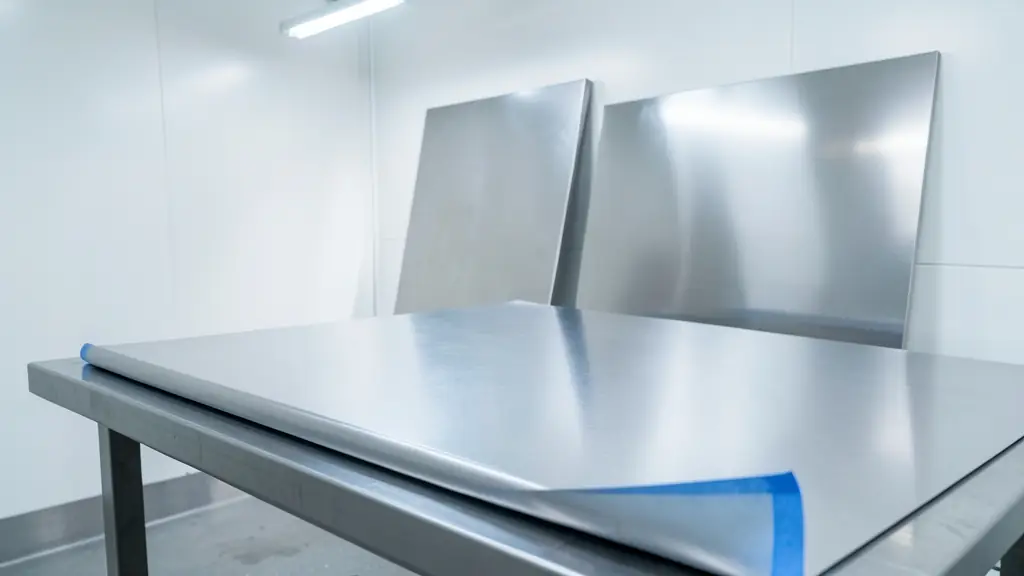
Order stainless from a merchant and the first questions back are about the surface and the setting. A splashback in a Bryanston kitchen, a cold room wall in a Ceres packhouse and a balustrade on a Plettenberg Bay deck all start as stainless sheet, yet they need different finishes and sometimes different grades. Getting either wrong shows up later as brown marks, scratches that cannot be blended out or a sheet that cost more than the job needed.
Price guide
A stainless stockist lists 2500 x 1250 mm 304 sheet from about R1,420 for 0.9 mm to R4,450 for 3 mm and 316L from about R5,085 for 2 mm, excl. VAT, and a mill factory shop lists 304L sheets at R1,800 for 1 mm and R4,400 for 2.9 mm.
A rough guide from published South African prices. Thickness, coating, length, cutting, delivery and VAT all move it.
Which finish suits a splashback, a counter or a plant?
- 2B: the standard cold rolled mill finish, smooth and matt grey. It is the usual choice for food plant cladding, tanks, hoppers and anything that will be welded and cleaned rather than admired.
- Bright annealed (BA): close to a mirror straight from the mill, used for trim, reflectors and decorative panels. It shows every fingerprint.
- Brushed, often called No. 4: fine parallel polishing lines. Kitchens, lift doors, counters and splashbacks use it because small scratches blend into the grain and can be rubbed out along it.
Sheet is commonly sold in 1219 x 2438 mm, 1250 x 2500 mm and 1500 x 3000 mm, mostly from about 0.5 mm to 3 mm, with 0.9 mm, 1.2 mm and 1.5 mm among the busiest thicknesses.
When is 316 worth paying more for?
Grade 304 handles kitchens, inland food plants, cold rooms and most indoor work. Grade 316 adds molybdenum, which resists chlorides: salt air, pool water, brine, some cleaning chemicals. Within a few kilometres of the sea, around pools and in fish or pickling plants, specify 316. Indoor pool halls are harsher than they look, so load bearing fixings there are for an engineer to choose. Grade 430 is a cheaper magnetic stainless for dry indoor trim and appliance panels.
What is tea staining, and can I stop it?
Tea staining is a light brown film that appears on coastal stainless, worst on rough finishes and in sheltered spots the rain never washes. It is surface corrosion, mostly cosmetic. A smoother finish, 316 rather than 304, and a rinse with fresh water every few months keep it away. Stainless cleaner lifts it. Never use steel wool or a carbon steel brush; the loose iron particles rust on the surface.
Should the protective film stay on?
Keep the film on while the sheet is cut, folded and fitted; it saves the finish. Take it off within weeks once fitted, and soon on outdoor work, because sun bakes the adhesive on. For folded and welded parts see sheet metal fabrication, and check the mass of large panels with the sheet weight calculator.
Who asks for this
- Homeowners and DIY
- A splashback behind the hob, a braai area worktop or a coastal balustrade infill.
- Builders and contractors
- Lift lining, balustrades, kick plates and cladding details on coastal or public buildings.
- Farms and smallholdings
- Dairy and packhouse cladding, wash troughs and tables that must survive hosing every day.
- Factories and workshops
- Food and pharma plant panels, hoppers, tanks and guards that are washed down daily.
- Shopfitters and signwriters
- Restaurant counters, bar fronts, display shelves and hygienic wall panels in kitchens.
- Schools, clinics and municipalities
- Hospital and school kitchens, clinic sluice rooms and ablution fittings that resist vandals.
- Mines and plants
- Chemical and water treatment parts where acids or chlorides attack mild steel.
- Resellers, fabricators and installers
- Kitchen fabricators and shopfitters ordering sheet by grade, finish and thickness.
Frequently asked questions
Is all stainless food safe?
Grades 304 and 316 are the normal choice for food contact, but ask the supplier for the mill certificate so the grade is on paper, and keep welds ground smooth so they can be cleaned.
How do I tell 304 from 430 on site?
A magnet is a rough first test: 430 grips strongly, annealed 304 hardly at all. Cold working can make 304 slightly magnetic, so the mill certificate is the real proof.
Can stainless be cut with an angle grinder?
It can, with a disc made for stainless that has not touched mild steel. Heat discolours the edge, and sparks landing on the face of nearby sheets leave rust spots, so cover them.
Who sends the quote for stainless sheet?
Stainless merchants, cut to size services and fabricators that cover your area. We pass your request on and they price it; we hold no stock ourselves.