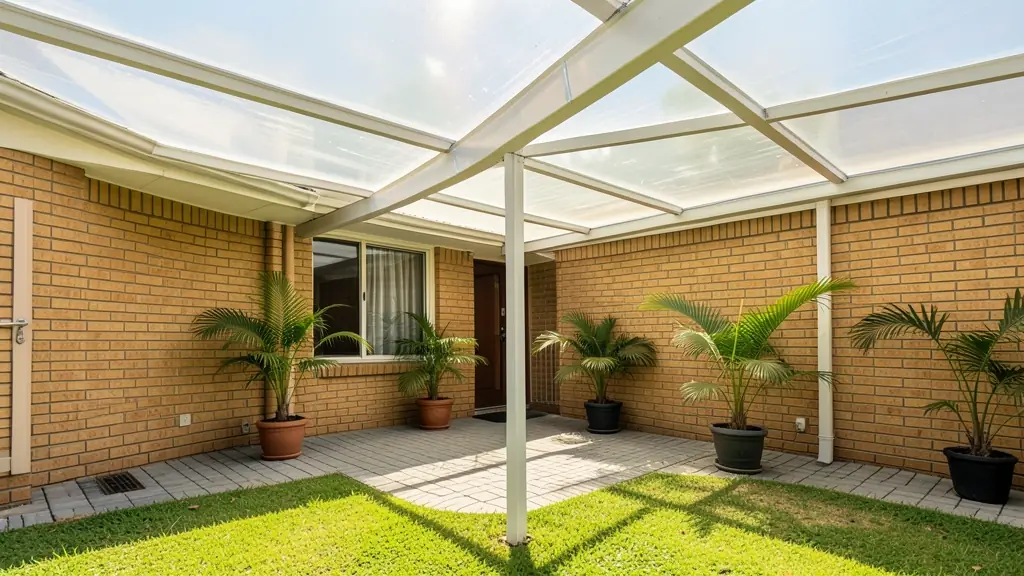
Polycarbonate grows about five times as much as steel for each degree. A sheet fixed tight in winter bows in summer heat, and one fixed tight in summer pulls at its screws on a frosty morning. This calculator gives the movement for polycarbonate, acrylic, PVC, fibreglass, aluminium or steel from the sheet length and a local temperature range, then the end gap and the hole to drill. Types and fixing are on the polycarbonate sheets page.
Which temperatures should I type?
The coldest default, about -2 °C, is a winter dawn on the Highveld; at a frost free coast use more. The hottest depends on the sheet more than the weather, because the sheet soaks up sun: clear runs at about 55 °C, opal or bronze about 70, a dark or solid colour about 80, and a sheet indoors or in shade about 35. Over a dark frame, allow for more.
How far will the sheet move?
The sum is the material's movement per metre per degree, times the length, times the range. A 6 m opal polycarbonate sheet going from -2 to 70 °C moves about 28 mm, roughly 5.4 times a steel sheet of the same length. Fixed from the middle, that is about 14 mm at each end, the gap the ticket gives against a wall flashing, a channel or the next sheet. Across a 1 m width the sheet moves about 4.7 mm.
How big should the screw holes be?
Near the ends, where a sheet moves most, our rule is a hole the size of the screw plus half the movement, and at least 2 mm bigger than the screw. For a 6 mm screw in that 6 m sheet the ticket gives 20 mm, wider than most sealing washers can cover. Then use shorter sheets, a bar system the sheet can slide in, or the fixings the sheet maker offers for long lengths. Use a drill bit meant for plastics, fix through the crown of a profiled sheet and do not overtighten.
What should I tell the supplier?
Give the sheet type (solid, multiwall or profiled), the thickness, the colour, each length and the number, and say how it is held: screws into purlins, or bars and channels. Ask for the fixing guide with the screws, washers and flute tape to suit, and check the UV protected face goes up. Never stand on a polycarbonate roof, because it breaks underfoot; leave the fixing up there to a roofer. Light sheets in a steel roof are covered under plastic roof sheeting, and signs and guards under acrylic sheets.
Frequently asked questions
How much gap does a 3 m polycarbonate sheet need?
A clear 3 m sheet going from -2 to 55 °C moves about 11 mm, so fixed from the middle it needs about 6 mm at each end. An opal or bronze sheet of the same length runs hotter and needs about 7 mm.
Does acrylic move more than polycarbonate?
A little: about 0.075 mm per metre per degree against 0.065, roughly 15% more. Acrylic is also more brittle, so a tight hole is likelier to crack it.
Does fibreglass sheeting move less?
Yes. Fibreglass (GRP) moves about 0.025 mm per metre per degree, well under half of polycarbonate and about twice steel, so it sits more happily in a steel roof.
Why did my sheet crack at the screws?
Most often the holes were too tight for the movement, the screws were overtightened, or the holes sat too close to an edge. Have a cracked sheet replaced from a ladder or by a roofer, never by walking on the roof.
Read more
More tools
- Roof sheeting calculatorRoof shape, eaves length, sheet run and profile: sheets to order, the cut length, end laps and ridge capping
- Sheet weight calculatorMaterial, shape, thickness, length, width and count: the total mass, each sheet, kg per m² and who can lift it
- Sheet metal gauge converterA gauge number and system, or a thickness in mm: the millimetres, the nearest gauge, kg per m² and the stocked size
- Board calculatorWall, floor or ceiling size less openings, board size and cut allowance: boards to order, a grid count and the spare
- Plastic sheeting calculatorArea, edge turn ups, overlaps, micron and roll size: rolls to order, the strips, film used, its mass and the left over